

A human + AI experiment in historical storytelling, research, and getting a train to finally go the right direction.
Something about Oregon during the late 1800s and early 1900s. has always sparked my imagination. There are so many extraordinary stories from this period - railroads, dangerous ports, rapidly growing towns, immigration, fortunes being made and lost, and people arriving in a place that was changing almost by the day.
I've often wondered why more of these stories haven't been explored. But for most of my life, I never felt particularly confident trying to write them myself. I've struggled with dyslexia my entire life. I can visualize a scene, understand characters and imagine worlds, but translating all of that into writing can be frustrating.
Recent advances in AI changed that. For the first time, I felt like I had a collaborator that could help me get ideas out of my head quickly enough that I could actually explore them.
The fun part
I started with a few small historical-fiction ideas. ChatGPT and I brainstormed characters, scenes, visual storytelling, and ways of making Oregon almost a character itself. The process was ridiculously fun. Ideas became scenes. Scenes became sequences. Sequences started becoming stories.
I shared some of the early writing with close friends and relatives. They wanted to keep reading. That made me wonder whether there might actually be something here worth pursuing. So I pushed deeper. And that's when AI and I started getting into trouble.

The beautiful problem
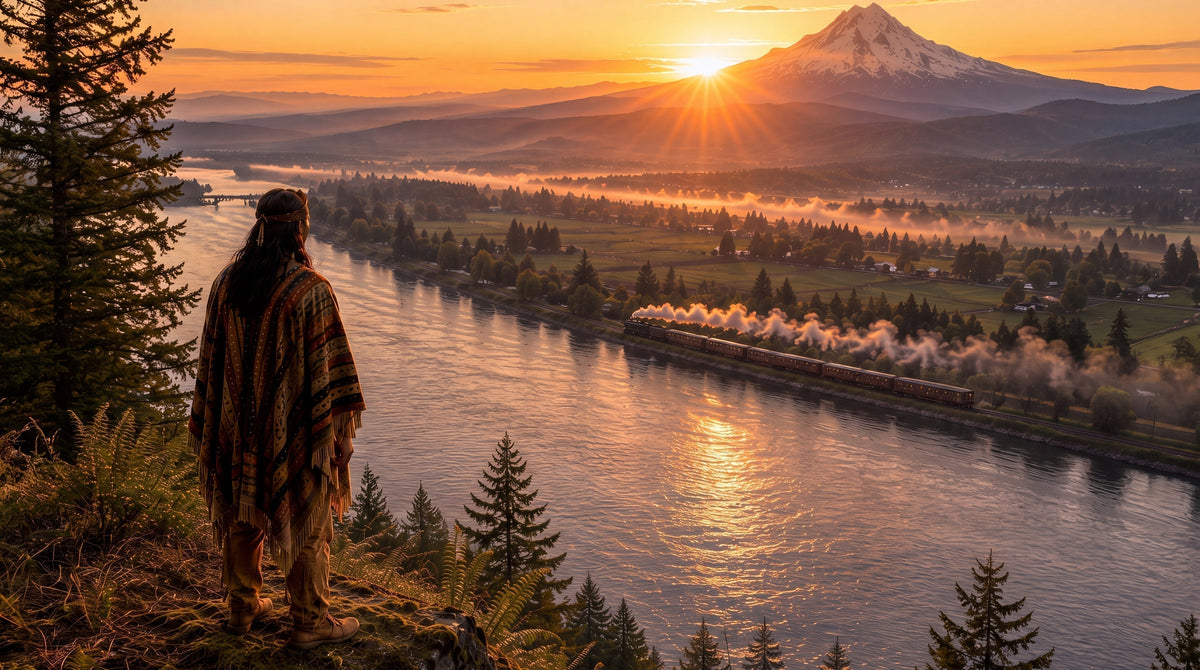
For one story, we wanted to introduce a man traveling toward Portland in the late 1800s. We imagined an enormous cinematic opening: a Native person observing the landscape from above at sunrise, and then a tiny steam train entering the frame—carrying our protagonist toward Portland and representing another wave of change moving into the region.
We generated the scene, and it was beautiful. Really beautiful. The kind of image that makes you think: this could actually be a movie.
There was only one problem: it wasn't history.
Then I started asking annoying little questions
How exactly did this man get to Portland? Where did his train stop? Which railroad was he riding? Which direction was it traveling? Where did he get off? What would he see when he stepped onto the ground? How would he actually get from the railroad into Portland?
Those questions sound trivial. They weren't. The deeper I went, the more I realized ChatGPT and I had built an incredibly convincing world on top of assumptions.
Then the curious part of my brain started poking me and wouldn't stop. So I did something decidedly less futuristic: I went to the library. Then historical societies. Then museums. Then archives.
At the Oregon Historical Society I was able to look at authentic railroad maps covering the region from the late 1800s into the early 1900s. That was the moment the movie in my head had to change.
We hadn't created historical fiction. We'd created fiction wearing historically convincing clothes.

The map changed the movie
The research didn't destroy the idea. It made it better. Instead of forcing our character through a route simply because it gave us a spectacular image, we started rebuilding the sequence around transportation and geography that could actually support the story.
That changed the railroad. It changed where our character arrived. It changed how he reached Portland. It changed what he could see from the train. And ultimately it changed the opening itself.
Then the image generator and I had an argument
Understanding the geography didn't mean the image generator would draw it correctly. We could tell it the train was northbound. It generated a gorgeous train traveling south. We corrected it. Another gorgeous train traveled south.
 Eventually we stopped speaking geography to the image model and became comically literal: ENGINE ON LEFT. PASSENGER CARS ON RIGHT. SMOKE TRAILS RIGHT.
At one point the train appeared to be traveling through the river. In another attempt, Mount Hood migrated across the landscape toward where Mount St. Helens should have been. The east side of the river became Portland. Every image looked plausible. Several were spectacular. Several were completely wrong.
Plausible isn't the same as accurate
That may be the most important thing I've learned from this experiment. AI is extraordinarily good at producing plausibility. Give it enough context and it can generate something polished, authoritative, and completely believable.
That's incredibly useful. It's also potentially dangerous when working with history, because the more beautiful the output becomes, the easier it is to stop questioning it.
AI helped me understand unfamiliar subjects. It helped me identify questions I didn't know I needed to ask. It helped me visualize maps, transportation systems, historical environments, and scenes. And because of my dyslexia, it dramatically lowered the barrier between an idea in my head and something I could actually begin developing.
But AI couldn't replace the moment when someone at a historical society put a real railroad map in front of me. That map changed the story.
The collaboration is the interesting part
I've started thinking about AI less as an oracle and more as an extraordinarily fast creative collaborator. Sometimes it's brilliant. Sometimes it's confidently wrong. Sometimes it helps me discover something I never would have considered. And sometimes I have to tell it, for the fifth time: THE ENGINE GOES ON THE LEFT.
The human part of the process hasn't disappeared. If anything, I've found myself doing more research because of AI, not less. I'm reading old newspapers. Looking at maps. Visiting libraries and museums. Talking to archivists. Questioning tiny details I probably never would have noticed before.
AI accelerates the exploration. Human curiosity determines whether the exploration goes anywhere worthwhile.
Back where we started - but better
The final opening still contains the same basic idea that excited us at the beginning: an extraordinary Oregon landscape, an observer, and a tiny mechanical object moving through it that represents enormous change.
Maybe that's the relationship I'm most interested in. Not human versus AI. Not even AI replacing human creativity. It's what happens when a human and an AI keep challenging each other.
Sometimes you end up almost exactly where you started. Except now you understand why the train is going that direction.
And somehow that makes the picture better.

Share:
Testing OpenArt Vibe Video in a Real AI Production Workflow